


Financial pressure is increasingly following UK employees into the workplace, with new research finding that almost two-thirds of workers are worried about money and one in six say financial stress is affecting their performance at work.
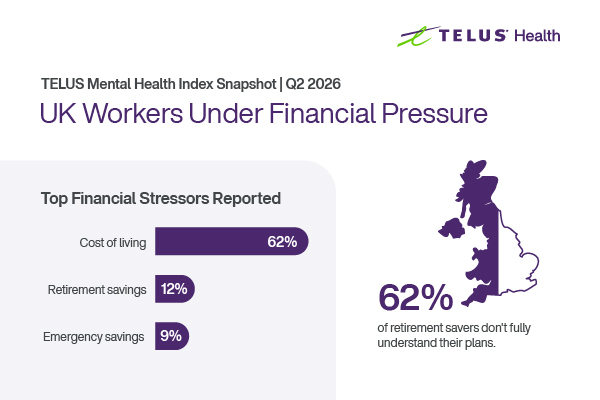
The latest TELUS Mental Health Index reveals that the cost of living remains by far the biggest financial concern for employees, cited by 62% of UK workers. This compares with 12% who identify retirement savings as their biggest worry and 8% who are most concerned about emergency savings.
The Q2 2026 research also highlights a potentially significant challenge for employers: financial wellbeing is not simply a personal issue for staff. Some 17% of respondents said their personal financial circumstances had negatively affected their productivity at work, while 3% had missed work altogether because of financial stress.
Paula Allen, Global Leader of Research and Insights at TELUS Health, said:
“Financial strain is showing up both in people’s mental health and in their ability to work effectively. Seventeen per cent of workers report a negative productivity impact from financial stress, while three per cent have missed work entirely because of it.
“The findings also point to an opportunity for employers: workers are asking for clearer support around retirement and savings, while psychological safety remains closely connected to mental health.”
Nearly Two-Thirds of Workers Experience Financial Anxiety
According to the Index, 62% of UK employees feel worried or anxious about their finances at least some of the time, while one in 10 say they always feel anxious about money.
The consequences appear to extend to overall mental wellbeing. Employees who said their financial circumstances were affecting their productivity recorded a Mental Health Index score of 46.3 – almost 26 points below workers who reported no productivity impact and more than 18 points below the UK average.
Meanwhile, 22% of workers do not have emergency savings sufficient to cover their basic needs.
The UK’s overall Mental Health Index score for Q2 stands at 64.7. Almost a third – 32% – of workers are considered to be at high mental health risk, with another 42% at moderate risk. Anxiety and isolation remain the two lowest-scoring areas in the Index.
Younger Employees Particularly Vulnerable to Money Worries
The research suggests that financial pressure is not being felt equally across the workforce.
Employees under 40 are three-and-a-half times more likely than those over 50 to say financial stress has negatively affected their productivity.
Managers and parents are also 70% more likely than their respective counterparts to report a negative impact on their work performance.
Another group facing considerable pressure is the so-called “Sandwich Generation” – employees simultaneously dealing with work and caring or financial responsibilities towards other family members.
A quarter of UK workers provide care or financial support to adult children, ageing parents or other relatives. Among those employees, 34% say the responsibility has negatively affected their finances, 26% report an impact on their mental health and 15% say it has affected their productivity at work.
Workers Don’t Understand Their Pension Benefits
The findings also expose a sizeable gap between the benefits employers provide and employees’ understanding of them.
Among workers contributing to a workplace retirement or savings programme, 62% do not have a strong understanding of how it works.
Five per cent say they do not understand their programme at all. This group recorded a Mental Health Index score of 48.7, compared with 72.3 among workers who said they understood their scheme very well.
This could present employers and HR teams with an opportunity to make existing benefits work harder by improving communication and financial education rather than necessarily introducing entirely new schemes.
There appears to be demand for that support. Some 59% of workers want employer-provided resources or assistance relating to retirement, pensions or savings.
Employees expressed interest in support covering retirement and long-term savings, workplace pensions, investing, emergency savings, tax planning, insurance and budgeting.
Mental Health Stigma Remains a Workplace Problem
Financial wellbeing is not the only concern identified in the report.
Despite years of employers encouraging more open conversations about mental health, more than a quarter of UK workers still say they would not feel comfortable telling their manager if they were experiencing a mental health problem.
While 53% would feel comfortable having that conversation, 27% would not. Those reluctant to speak to their manager also recorded Mental Health Index scores around 12 points lower than employees who would feel comfortable disclosing a problem.
Barriers are particularly apparent around substance-use problems. Stigma or embarrassment was cited by 25%, confidentiality concerns by 24% and fear of having to disclose the issue at work by 21%.
For employers, the findings suggest that providing an employee assistance programme or wellbeing benefits may not be enough on its own. Workers also need confidence that seeking support will remain confidential and will not damage their career prospects.
Financial Wellbeing Becoming an HR Issue
The research strengthens the argument for employers to view financial wellbeing as part of their broader employee wellbeing and productivity strategies.
Clearer pension communications, financial education, access to confidential support and training managers to handle sensitive conversations could all become increasingly important as household financial pressures continue.
The results also suggest employers should be cautious about assuming that younger employees are primarily concerned with immediate pay while older workers are focused on retirement. Although cost-of-living pressures dominate across the workforce, individual circumstances – including age, caring responsibilities and financial resilience – can substantially change the support an employee needs.
The TELUS Mental Health Index research was conducted online between 5 and 18 June 2026 among 2,000 people living in the UK who were either currently employed or had been employed during the previous six months. Respondents were selected to reflect the UK’s age, gender, industry and geographic distribution.